James Marsh's biopic of the celebrated scientist Stephen Hawking, The Theory of Everything, stars Eddie Redmayne as the famous figure. Enrolled as a graduate student at Cambridge, Hawking establishes himself as one of the leading minds of his generation, and begins to win the heart of Jane (Felicity Jones). After one of his earliest breakthroughs, Hawking is diagnosed with ALS, and he becomes less and less able to control his own body. With the loyal Jane at his side, he continues his work. However, as the years progress, Jane starts to feel more like a nurse than a wife, and Hawking begins to have feelings for a woman who is hired to care for him. The Theory of Everything screened at the 2014 Toronto International Film Festival.
Thursday, 11 May 2017

Film Industry - The Theory of Everything - Audience Positioning
Past exam question:
B1. Discuss the different ways audiences are positioned by your three main texts. [30]
Starter: Define these Key Media Studies terms (white boards):
Active Audience
Passive Audience
encoded signs and messages
In order to understand the relationship between the audience and the media text, it is important to know that all media text have a series of encoded signs and messages.
The audience decode these messages and different audiences will decode them in different ways.
Media texts and the industries are acutely aware of their audiences.
To understand the position that the audience will take dependent on certain factors.
The relationship between media and audience is fluent and changing
Audiences are not a mass and their responses are complex and sophisticated
Audiences are made up of individuals - Either PASSIVE OR ACTIVE
Active Audience - This audience responds to and interprets the media text in different ways and actively engages with the messages.
Passive Audience - This is an audience that does not engage actively with the text. They do not question the text and therefore accept the preferred reading without challenge. They therefore might be more affected by the messages contained within the text.
Active Audience - This audience responds to and interprets the media text in different ways and actively engages with the messages.
Passive Audience - This is an audience that does not engage actively with the text. They do not question the text and therefore accept the preferred reading without challenge. They therefore might be more affected by the messages contained within the text.
Genre theory of everything from aealey
1. Opening Scene – Bikes in Cambridge: 00:00- 02:12
|
2. Jane Meets Stephen: 02:12-05:25
|
3. Family
Dinner: 12:35-14:00
|
4. Montage
of Home Movies: 01:07:00-01:09:00
|
5. Ending: https://www.youtube.com/watch?v=0RdvRJGl_w
|
Task 1: Watch the key scenes from The Theory of Everything and makle notes related to audience positioning.
Consider the following:
Sound.
Diegetic/non diegetic.
Lack of sound (Pure cinema)
Dialogue
and tone of voice
Edit.
Is it clear who's point of view?
Does the editing (through shot-reverse shot) put anyone in a dominant positionm?
Shorter shots (fast paced editing) to add drama?
Slow paced to show reactions?
Does it cut between hand held and tripod shots.
Lighting.
Is there any top lighting to make characters look intimidating?
Spotlight to isolate a character.
Warm or cool coloration to show human side or intensity.
High key, natural lighting to make audience feel comfortable?
Low key lighting to provide enigma and keep the audience hooked.
Framing.
Close ups to show emotion of characters and position the audience.
Wide shots to establish setting.
Up shots put a character in position of strength.
Down shots making character look vulnerable.
Eye level make audience feel comfortable.
Tracking shots positions the audience in the scene, with the characters/action.
How are the audience positioned through the use of technical codes?
Task 2: Attempt the exam question but relate only to The Theory of Everything.
B1. Discuss the different ways audiences are positioned by your three main texts. [30]
Saturday, 6 May 2017
Film Industry 2 Jurassic World - Industry
Marketing Jurassic World
Social media has the ability to weave its way into your day, silently influencing your decision making, plans or simply just introducing you to something completely new. With Jurassic World recently crowned the biggest opener weekend at the box office, we delved into the film’s social media profiles, to see if they roared as mightily as the film.
Social media has the ability to weave its way into your day, silently influencing your decision making, plans or simply just introducing you to something completely new. With Jurassic World recently crowned the biggest opener weekend at the box office, we delved into the film’s social media profiles, to see if they roared as mightily as the film.
Ahead, find 5 lessons we learnt from Jurassic World’s social media strategy…
1. Bring your brand to life – Jurassic World used their Facebook page not to represent a film, but real-life theme park (its category is even travel/leisure). Image assets help bring the park and the film to life, especially those of Mr. DNA, who also appeared in the original Jurassic Park films, for a big dose of nostalgia. His happy, innocent character was designed to explain the science behind Jurassic Park, so using his character on social is a great way to bring story-telling from the film to social media.
This, in turn, gives image assets like the example below of Mr. DNA a real emotive edge, an absolutely crucial skill to harness on social. According to an infographic by NeoMam Studios, it only takes one tenth of a second for your brain to process a visual scene, so it’s no wonder that images lead to engagement on social media.
2. Treat each platform in a different way – whilst the Facebook page has been used exclusively as a fictional theme park, Twitter‘s fast-paced nature gives the film more space for promotion, with actor Q&A’s, screenshots from the previous movies and exclusive video clips. It’s a great strategy – Facebook, after all, is all about the emotion, whilst Twitter is much more news-led.
3. Get started early – The social media campaign for Jurassic World started exactly one year before its release date. That may seem crazy, but it’s definitely worked in getting the buzz going. Don’t hesitate to get your social media strategy going; it could pay off dividends in the long run.
4. Consider out-of-the-box tactics – a year before its release, an unofficial Twitter account tweeted photos of a brochure for the Jurassic World theme park, even boasting one of its attractions as having an instruction video hosted by Jimmy Fallon. A really interesting tactic, which got people talking very early on.
5. Share teasers from influencers for even more buzz – Colin Trevorrow, the director of the film, is an avid tweeter. Since filming began in April 2014, he was tweeting photos that may seem futile to non- Jurassic fans, but to the fans, these were cleverly crafted snaps which left people wondering and anticipating. The below tweet, for example, is a sign that featured in the original Jurassic Park movie, pointing to the East Dock on Isla Nubar. Garnering a buzz like this from an influencer can really steer the sentiment from indifferent to piqued interest.
Film Industry - Jurassic World - Audience Responses
Past Exam Question:
B1. Discuss the different ways audiences may respond to your three main texts.
[30]
B1. Discuss the different ways audiences may respond to your three main texts.
[30]
Starter: Define these Key Media Studies terms (white boards):
- Oppositional readings
- Polysemic
- Decode the messages
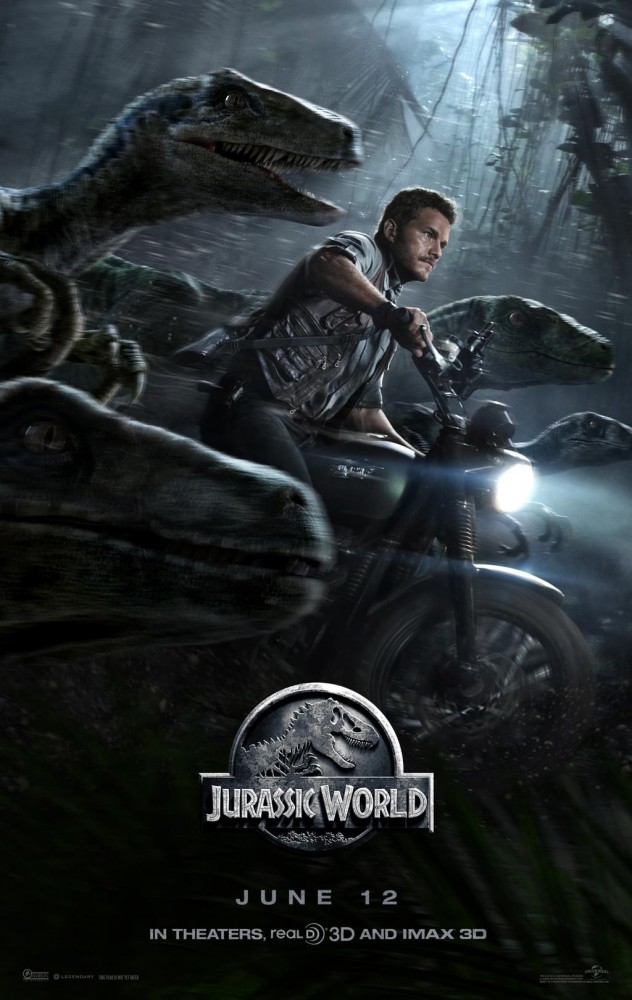
Starter continued:
Look at the poster above.
Identify the visual codes used
Identify the technical codes used
What do you think (and why) is the target audience for the movie Jurassic World?
Task 2:
Watch the key scenes and consider how different audiences may respond (Stuart Hall).
A. Stand Down
https://www.youtube.com/watch?v=Q3znhTOUqi8&t=36s
B. Mosasaurus scene
Task 3:
Look at the specific extracts which are shown above.
In the boxes on the handout provided, comment on each of the following:
What do you think (and why) is the target audience for the movie Jurassic World?
___________________________________________________________________________
Some Reviews of Jurassic World. These are 'actual audience responses':
Task 1:
Watch this behind the scenes clip and consider the themes encoded in Jurassic World.
Watch this behind the scenes clip and consider the themes encoded in Jurassic World.
Task 2:
Watch the key scenes and consider how different audiences may respond (Stuart Hall).
A. Stand Down
https://www.youtube.com/watch?v=Q3znhTOUqi8&t=36s
B. Mosasaurus scene
C. Gyrosphere
D. Bryce Dallas Howard
Look at the specific extracts which are shown above.
In the boxes on the handout provided, comment on each of the following:
- Polysemic? Does the scene have several different messages encode
- Preferred, dominant, negotiated and oppositional readings (S. Hall).
- Audiences reasons for “using” it (Uses and Gratification theory).
Quotes from the director Colin Trevorrow:
There’s a story about a tiger that had been raised in captivity that got loose and just went on a killing spree, like a serial killer. And it killed everything in its path, every living thing that it came upon. And so we based [the Indominus story] on that, and there are examples all over of animals raised in captivity not necessarily having the same psyche, the same mindset as animals that have grown up in a more traditional environment.
Bryce Dallas Howard's character gives no regard for the holographic dinosaurs in the visitor center. She simply walks right through them, completely unimpressed. This symbolizes her view of the dinosaurs as nothing more than data, rather than living, breathing animals
Interview with the director Colin Trevorrow:
Home work: Plan and essay response to the past exam question:
Discuss the different ways audiences may respond to your three main texts.
Refer only to Jurassic World.
Bryce Dallas Howard's character gives no regard for the holographic dinosaurs in the visitor center. She simply walks right through them, completely unimpressed. This symbolizes her view of the dinosaurs as nothing more than data, rather than living, breathing animals
Interview with the director Colin Trevorrow:
Home work: Plan and essay response to the past exam question:
Discuss the different ways audiences may respond to your three main texts.
Refer only to Jurassic World.
Thursday, 4 May 2017
Monday, 1 May 2017
Film Industry Jurassic World - Audience Positioning - KEY SCENES
Past exam question:
B1. Discuss the different ways audiences are positioned by your three main texts. [30]
In order to understand the relationship between the audience and the media text, it is important to know that all media text have a series of encoded signs and messages.
B1. Discuss the different ways audiences are positioned by your three main texts. [30]
In order to understand the relationship between the audience and the media text, it is important to know that all media text have a series of encoded signs and messages.
The audience decode these messages and different audiences will decode them in different ways.
Media texts and the industries are acutely aware of their audiences.
To understand the position that the audience will take dependent on certain factors.
The relationship between media and audience is fluent and changing
Audiences are not a mass and their responses are complex and sophisticated
Audiences are made up of individuals - Either PASSIVE OR ACTIVE
Active Audience - This audience responds to and interprets the media text in different ways and actively engages with the messages.
Passive Audience - This is an audience that does not engage actively with the text. They do not question the text and therefore accept the preferred reading without challenge. They therefore might be more affected by the messages contained within the text.
Active Audience - This audience responds to and interprets the media text in different ways and actively engages with the messages.
Passive Audience - This is an audience that does not engage actively with the text. They do not question the text and therefore accept the preferred reading without challenge. They therefore might be more affected by the messages contained within the text.
Task 1:
- Watch the trailer for the movie Jurassic World.
- List any messages/themes that you can identify within the trailer.
- Consider - How animals are treated today:
- Kids love animals but are animals mistreated/exploited?
- An animal experiences life with feelings and awareness. Many of our foods have been genetically modified for decades, and now as technology improves, the debate about genetically modified animals has begun.
- By measuring an animal's worth in financial terms, we place the health and well-being of the animal into an inferior role.
- Why could animal isolation in a zoo for example be considered to be torture?
- How does the film focus on the relationship between people and animals?
Task 2: Go to the edit suite. Read the article on the link below
Write a short essay about the way Jurassic World positions audiences to consider the themes you have identified. 200 words - email to me.
ealey_a@sjd.ac.uk
Subscribe to:
Posts (Atom)